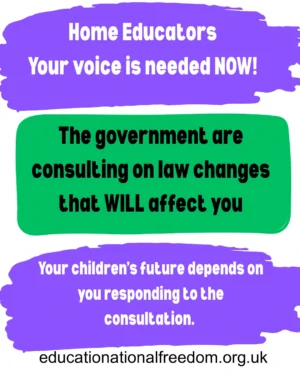
The Department for Education has launched its consultation on the draft statutory guidance for Children Not in School. This is an opportunity for home educating families to have their say on how some of the most significant changes to home education in recent years will operate in practice.
And if you think these changes won’t affect you, think again.
We are not simply talking about a new register or a few extra administrative requirements. We are talking about a significant expansion of local authority involvement in the lives of home educating families, more information being collected about our children, increased scrutiny of where and how they learn, and new processes that could make choosing home education considerably more difficult.
So what is actually at stake?
1. Home education risks becoming an increasingly intrusive experience.
The Children Not in School registers will require families to provide information about their children, their home addresses, the parents providing education and estimates of how much education is provided by parents and other people.
Think about what that means in practice.
A family might use a combination of museums, libraries, online learning, informal groups, tutors, educational visits and independent projects. Their child’s education might look completely different from one month to the next.
Will families feel pressured to account for every change? Will local authorities start treating estimates as targets? Will parents feel they have to justify how much time they personally spend teaching their children?
Home education is not a school timetable conducted at home. We should not be creating a system in which parents feel they must constantly account for their educational choices.
2. More opportunities for local authority intrusion into family life.
The legislation introduces powers and requirements relating to the consideration of children’s home and other learning environments, including the power to request home visits.
This raises serious questions about privacy, consent and the boundaries between a family’s private life and its educational responsibilities.
A child might learn in their bedroom, the garden, the local library, a museum, a friend’s home or while travelling. Their home does not need to resemble a classroom to provide a suitable education.
What happens when an officer’s expectations of a suitable learning environment are based on their own assumptions about what education should look like?
What happens when a family feels pressured to agree to a visit because they fear refusing will lead to further scrutiny?
We must ensure that home education does not become an excuse for routine intrusion into private family life.
3. Children who need to escape school could face another barrier.
One of the most concerning developments is the proposed pilot of mandatory meetings before children can be removed from school to be home educated.
Consider a child experiencing severe anxiety, school-based trauma, bullying or emotionally based school avoidance.
Their parents may have spent months trying to get appropriate support. They may have reached the point where removing their child from school is essential to their wellbeing.
Now imagine being told that, before you can withdraw your child, you and your child must attend a meeting.
For a child who struggles to enter the school building, communicate with unfamiliar adults or even talk about their experiences, this could be an incredibly distressing requirement.
A child should not have to sit in a room explaining why they cannot cope with school before their parents can exercise their right to educate them otherwise.
The government may describe these meetings as an opportunity to provide information and support. But we must ask whether compulsory meetings will genuinely help families or simply create another hurdle at precisely the moment they need to make a decision.
4. Children with SEND could be particularly affected.
Many families turn to home education because schools have failed to meet their children’s needs.
For some, home education provides the opportunity to recover from years of anxiety, sensory overload, unmet needs and negative experiences of the education system.
The legislation also introduces additional consent requirements for certain children, including those attending special schools and those subject to specified child protection arrangements.
These are particularly significant restrictions on parental choice.
We need to question whether the people making decisions understand the circumstances that lead families to home educate in the first place. A child having additional needs does not automatically mean that school is the right environment for them.
5. Independent education providers could find themselves under increased scrutiny.
The new framework also places information requirements on certain people providing education outside school, once the prescribed threshold is met.
This could have implications for tutors, small educational groups and other independent providers.
We need clarity about how these requirements will work, who will be affected and how the information will be used.
We should not allow a system designed to identify children missing education to create unnecessary barriers for the many people and organisations providing valuable educational opportunities outside school.
6. The biggest danger: changing the culture of home education.
Perhaps the most important issue is not any single provision. It is the cumulative effect of them.
Home education works because families can make decisions based on their individual children’s needs. There is no single correct way to home educate.
Some families follow structured programmes. Others take an autonomous approach. Some use tutors, online courses or groups. Others learn through everyday experiences, interests and projects. Many combine several approaches.
A child might spend months recovering from school-related trauma before becoming ready to engage with more formal learning. Another might learn advanced mathematics independently while spending much of their time pursuing a particular interest.
None of these approaches should automatically be viewed with suspicion simply because they do not resemble school.
If parents become frightened of doing things differently, worried about refusing requests or anxious that every educational decision might be questioned, we risk losing something fundamental about home education: the freedom to provide an education that is genuinely suited to the individual child.
This is why your response matters.
The legislation has already established much of the new framework. However, the statutory guidance will shape how local authorities are expected to operate within it. The details matter enormously.
We need the government to hear about the real consequences these measures could have.
Tell them about children who cannot tolerate compulsory meetings. Tell them about families who have experienced inappropriate local authority demands. Explain why a home is a private space, why education cannot be measured by hours spent sitting at a desk, and why parents should not have to prove that their approach resembles school.
Explain why children with SEND, children recovering from trauma and children whose needs have not been met by schools must not be disadvantaged by these changes.
And please don’t assume that somebody else will do it for you.
It is not enough for a handful of organisations to respond. It is not enough for a few experienced home educators to speak up. The government needs to hear from thousands of individual families, with different experiences, different approaches and different reasons for choosing home education.
Home education belongs to families, not local authorities.
We have a responsibility to make sure that the people shaping its future understand what they are putting at risk.
Please read the consultation. Consider the questions carefully. Respond honestly and explain what these changes could mean for your family and your children.
Don’t stay silent and then wish you had spoken up when these measures become part of everyday life.
Your home education freedom is worth defending. Make your voice count.
Make sure to find us on social media.
Staffordshire website design and website SEO by Fellowship Studios.