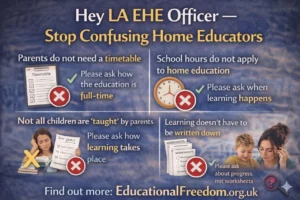
If you work in a Local Authority Elective Home Education (EHE) team, this message is for you.
Many home educating families are not refusing to cooperate. They are not trying to be difficult. They are simply confused.
And very often, that confusion comes from the language being used by Local Authorities.
The problem is simple: too much of the communication with home educators uses school language.
Home education is not school.
But many letters, forms, and conversations treat it as if it is.
One of the most common examples is the word timetable.
Parents are frequently asked to provide a timetable or explain their “daily schedule”.
But the law does not require a timetable.
The legal requirement is that education must be full-time, meaning it takes up a significant portion of the child’s life.
Full-time education can include reading, projects, conversations, outings, hobbies, research, practical activities, and many other forms of learning.
It does not need to be divided into neat hourly blocks.
When LAs ask for a timetable, parents understandably assume they are expected to recreate school at home.
That is not what the law says.
Another common issue is when LA officers talk about school education being 20-25 hours a week.
There is no legal requirement for home education to follow these hours.
Learning may happen in the morning, afternoon, evening, or spread throughout the day. It also may happen all throughout the year.
Some children learn best in short bursts. Others prefer long stretches of focus. Some learning happens through everyday life.
Trying to measure home education against school hours simply doesn’t make sense.
Another word that often appears in LA communication is taught.
Parents are asked:
But home education does not always work that way.
Children often learn through:
Parents guide, support, and facilitate learning — but they are not always standing at the front of a classroom delivering lessons.
Using the language of “teaching” and “lessons” can give the impression that formal instruction is required.
It isn’t.
Another persistent myth is that learning must be recorded in written work.
Parents are often asked to provide samples of work, exercise books, or written assignments.
But learning does not always produce written evidence.
A child discussing history, building something practical, exploring nature, or researching a topic online is still learning.
Home education does not have to generate a pile of worksheets or even a photo to be valid.
When Local Authorities use school language, it sends a clear message to parents:
Home education should look like school.
That message causes unnecessary stress.
Parents start worrying that they must produce timetables, written work, formal lessons, and structured teaching in order to satisfy the LA.
Children who left school because it wasn’t working can suddenly find school recreated at home.
This isn’t helpful for families, and it isn’t an accurate reflection of the law.
If Local Authorities want clearer communication with home educators, the solution is straightforward.
Use language that reflects the law and the reality of home education.
Instead of asking for:
Ask parents to describe:
That simple change in language would remove a huge amount of confusion.
Or even better still, signpost them to correct information such as our website.
Home education is not school at home.
It is a flexible way of providing education that adapts to the child.
When Local Authorities recognise that difference and adjust their language accordingly, communication with families becomes far easier.
Until then, many home educators will continue to spend unnecessary time explaining that education does not have to look like school to be suitable.
Make sure to find us on social media.
Staffordshire website design and website SEO by Fellowship Studios.