When families start home educating, one of the first things they usually do is look for advice.
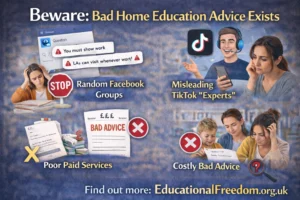
They join Facebook groups.
They watch TikTok videos.
They ask questions in online communities.
Or, they trust the LA has given them accurate info.
At first this seems like a great way to learn.
But there is a serious problem with relying on random online advice.
A lot of it is wrong.
Many home education Facebook groups are full of well-meaning parents sharing their experiences.
That can be helpful sometimes.
But experience is not the same as accurate legal knowledge.
You will often see comments like:
None of these things are legal requirements.
But when the same advice is repeated again and again in groups, new families often assume it must be true.
That misinformation can cause parents to worry unnecessarily or to give Local Authorities information they were never required to provide.
TikTok and other social media platforms have also created a new type of “expert”.
Short videos explaining how to “do home education properly” can look very confident and convincing.
But confidence is not the same as accuracy.
Many of these creators are simply describing their personal approach, not the law.
Others unintentionally spread incorrect information about what Local Authorities can demand.
Unfortunately, short videos rarely explain the legal framework properly, and new families may walk away believing things that simply are not true.
Some LAs do not hide the fact they want to bring down the number of home educators, others shout loudly that they want to improve their service to be helpful. But when you don’t have the existing knowledge of home education law you are not going to know which LA is being truthful and which has an agenda.
Another issue that has appeared in recent years is services charging families for advice that is often incorrect or unnecessary.
Some long-established organisations have recently developed a reputation for giving poor or outdated guidance.
Families are sometimes encouraged to:
In many cases, the information parents actually need is freely available including on our website.
Worse still, some of this paid advice tells families to comply with demands that are not required by law.
This can leave parents feeling pressured, intimidated, and out of pocket.
Home education in England is legally straightforward.
Parents must provide a suitable education, but they have significant freedom in how that education is delivered.
Local Authorities have a limited role and limited powers.
When parents understand the law properly, many situations that seem frightening become much easier to deal with.
But when families rely on misinformation from social media or outdated advice, they can accidentally create problems that never needed to exist.
This is why it is so important to be cautious about where you get your information.
Ask yourself:
Following the wrong advice can lead to unnecessary stress, unnecessary compliance, and sometimes unnecessary expense.
For families looking for clear, accurate information about home education law, Local Authority enquiries, and how to respond confidently, resources like our website and carefully monitored social media, provide guidance based on the legal framework rather than rumours or trends.
Because when it comes to home education, good information is one of the most important tools a parent can have.
Make sure to find us on social media.
Staffordshire website design and website SEO by Fellowship Studios.